Sunday, November 13, 2016

What makes you an artist?

I think the question of whether a quilter is an artist has been circulating for a very long time.  There is a class of quilts called art quilts (defined as an original exploration of a concept or idea rather than the handing down of a “pattern.” It experiments with textile manipulation, color, texture and/or a diversity of mixed media. An Art Quilt often pushes quilt world boundaries."  But if you don't make art quilts, are you an artist?  I never thought I was, but I'm beginning to question that.

To further confuse issues, Modern Quilters believe they are pushing quilt world boundaries, but often argue vehemently that though they are artists, but don't make "art quilts."  They often call the quilts they make their "work," like any artist calls the things they make their "work."  If you google modern quilting you can see all the controversy associated with that movement; you'll see a ton over the year.  Here's my favorite: http://leniwiener.com/2013/06/the-modern-quilt-movement-and-controversy/ But ..... that doesn't answer the question of whether or not quilters are artists.
When you look up the definition for artist.  The text above is what you get.  And according to the third definition, "a person skilled at a particular task or occupation," a quilter can definitely be considered an artist.  And it doesn't seem to matter what "type" of quilts they make: art quilts, modern quilts, traditional quilts, foundation paper pieced quilts, English paper pieced quilts, or portrait quilts.  But it does seem to matter about the quilters skill.   Perhaps the level of skill is another reason I never saw myself as an artist.  Huffington Post had a great article about defining artists: , but it was published more than 5 years ago.  http://www.huffingtonpost.com/daniel-grant/how-do-you-define-artist_b_582329.html

There is something in that article that spoke to me. "Artists are people who call themselves artists."  And that may be all that is needed. I never thought of myself as an artist before, I never called myself an artist.  Why is that?  Because 1) I didn't think I was creative enough; 2) I didn't think I was good enough: and 3) I didn't create art quilts.  But since I have begun modifying and most lately designing quilts and quilt blocks; since I do feel like I am a master at some quilting techniques, or at least good enough to teach others; and since I recently learned how to make a fabric self portrait, I now feel like an artist and I am comfortable calling myself artist.  And maybe that's all that is needed.  If you think you're an artist you are. 

What do you think? Which of these are art?

https://www.themodernquiltguild.com/gallery
http://www.soulsgrowndeep.org/gees-bend-quiltmakers
http://texasquiltmuseum.org/exhibits-at-txqm.html
https://www.saqa.com/

In my opinion, it just doesn't matter.  Anyone who makes anything due to a feeling inside them, I consider an artist.  So whether you're following a pattern, improvising as you go, sewing traditional triangles, squares and rectangles together, or experimenting with mixed media --- if sewing and quilting is the way you get your feelings out (good, bad or ugly feelings), then I think you're an artist.  And I encourage everyone to let their inner artists out.  Be brave.  Try something new.  A new color pallet, a new technique, a new pattern or a totally new expression of yourself through a quilt.  Think you're an artist and you'll be an artist!


Wednesday, November 9, 2016

Hump Day is for Curves


Do you do sew circles or curves?  I have to admit, used to be afraid of them.  I've used the Quick Curve Ruler to make patterns with curves, but they're not a true drunkards path. I have a die for my Sizzix for the drunkard's path and I think it's time I tried it.  I did some research first on the block itself and how to make it modern.  Read below some of what I learned (cut and pasted from the sites listed).  You can google Modern Drunkard's Path and see plenty of pictures to motivate you.


I really liked this one from http://sotosewn.blogspot.com/2011/12/monday-path-of-modern-drunkard.html  I'm a fan of solids and symmetrical designs.  But there are so many options with this simple block . . . . if you're willing to try those curves.  So challenge yourself.

finished - modern drunkard's path

Drunkard's Path (The National Park Service website)
It is easy to imagine the origin of this name. The meandering diagonals resemble a drunkard's staggering walk. Sewing for a cause is an old tradition. Women made quilts to raise money and consciousness, both to promote the abolition of slavery and to promote women's rights. Women across the country were also involved in the Temperance Movement. By 1907, The Women's Christian Temperance Union had 350,000 members. Prohibited from voting, the Drunkard's Path was a popular way for a woman to express her opinion on alcohol and its use. It appears that more quilts were made for this cause than for any other.Although other colors were used, blue and white became the Temperance Union colors: white for purity and blue for water, the purest beverage available.

Drunkard’s Path (Fons and Porter’s website)
Just like the Log Cabin design, the Drunkard’s Path design can be traced all the way back to ancient Egypt. Archaeologists have unearthed this design on ancient Roman artifacts, as well. Quilters started using this design later in the 19th century and its origin in the quilting world is quite exciting. Once in the new colonies, several different names were used to describe the block’s new and different arrangements. Rocky Road to Kansas, Oregon Trail…and Wanderer in the Wilderness were just a few of the early aliases. Later on, Amish quilters added names such as Solomon’s Puzzle…and Endless Trail to the growing list of block names. Today, all of these names are used, but the most popular is still Drunkard’s Path.


Traditional to Modern: Drunkard’s Path (Albuquerque Modern Quilt Guild)
The history of the drunkard’s path block is both steeped in romanticism and history. Some theorized that the zig zag pattern of the blocks contained secret codes designed to aid slaves escaping through the Underground Railroad. However, some have found this notion unreasonable as slaves would have traveled at night and would have been unable to see quilting patterns in the pitch black of  night (1). Others assert that the history of the drunkards path lies mainly in the Women’s Temperance Movement.  Women sewed these quilts to promote the abolition of alcohol. The drunkard’s path was meant to symbolize a drunk’s staggering walk. Often, these quilts were sewn in blue and white, white representing purity and blue representing water, the purest of all beverages (2). This notion may be fanciful as well, “As a writer* in an 1898 issue of The Modern Priscilla stated, ‘Color harmony is the key-note to success [in patchwork], and simplicity the next most important consideration. . . . All things considered, pretty indigo blue and white print and white muslin combine beauty with the coveted old-time air more effectively than any style of cotton patchwork.'” Katherine B. Johnson, The Modern Priscilla (May 1898).” Today’s modern interpretation of the drunkard’s path hardly resembles quilts of the past. Modern Quilters make clever use of negative space and very nontraditional block layout. Often, the quilting (or stitching) on these modern quilts helps convey a story as much as the piecing. Although these quilts lack historical romanticism, they do not lack the rich stories of their makers.

Here’s some links to blogs and videos about sewing curves and using drunkard’s path blocks in modern quilts.  Check them out.  And if you know of others that you prefer (there are plenty out there), please add them in the comments.


https://www.youtube.com/watch?v=vULfFqqM3Uc

Tuesday, August 23, 2016

August is for barns

Doris Rice gave a great presentation on Barn Quilts.  She discussed the history, shared a great book, showed photos of Barn Quilts across the U.S., explained an easy way to make your own (at your own home or at the Queen's Rustic Retreat workshop) and showed off  a beautiful barn quilt that goes on the bed, not the barn.

We completed our Mini Quilt swap. Check out the happy swappers and beautiful quilts


Next month will be our annual business meeting and we'll be holding some Quilting Olympics.  Hope to see you there.

Sunday, July 10, 2016

July's meeting was hot

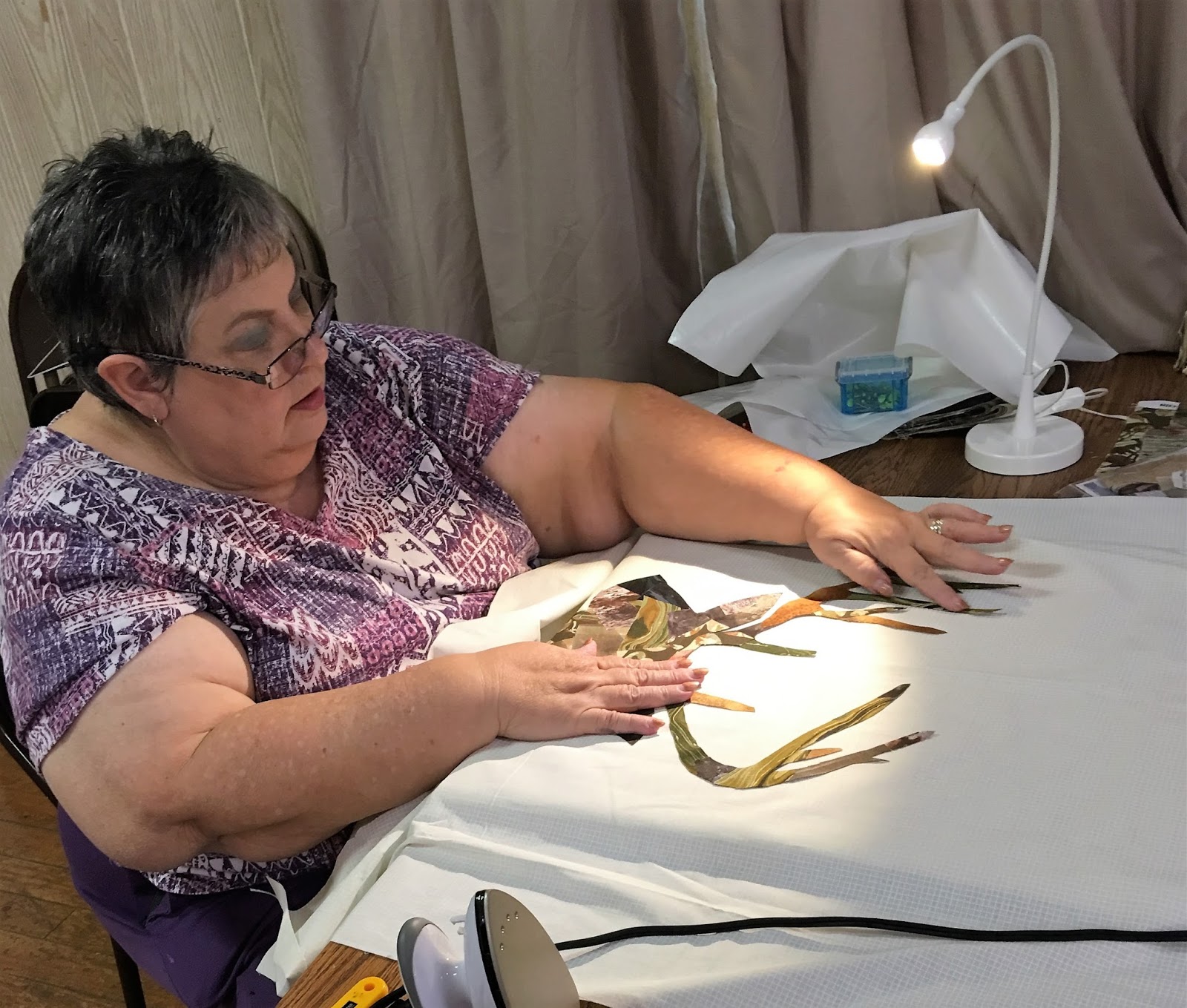
Our July program was provided by Shannon Brinkley who introduced us to Scrappy Bits Applique and her great technique for turning scraps into something awesome.  The meeting was changed to Friday and then a workshop was held on Saturday.  Workshop pictures are below.  There was no special project for July as in June we announced a Mini Quilt Swap due in August.  Don't forget to check out the Eye Candy page for the great show and tell from the meeting.


How do I quilt that?

Our June program was a presentation from Sharon Young on how to decide what kind of quilting to put on a quilt.  She gave us a list of questions to ask and think about before quilting anything. 
Understanding how the quilt will be used, who it is for (male, female, child, senior), and what their preferences are will make a big difference in how a quilt is quilted.  Folks brought in their half square triangle special project.  Look at what they created using an odd number of HSTs.  Don't forget to check out the eye candy page for show and tell pictures.


Sunday, May 22, 2016

May .... be I'll make a bag

Our presentation at the May meeting was from fellow guild member Sarah Gregg.  She shared tips and tricks on patterns, interfacing, batting, hardware and specialty supplies used in bag making.  She provided us info on what bag designers she liked and why and had samples for us to feel the difference between the different techniques and supplies. She talked about big bags for traveling, purses and even small little change purses or project bags.  She'll be hosting a bag sew along for anyone who is interested later this month. You'll be able to sew and get help on whatever bag you'd like to try or Sarah can provide some recommendations. Watch FB for information on that, as well as for links to some of her favorite designers and suppliers.

Members brought in 12 half square triangles and went home with 12 different ones.  The challenge is to make a block out of them (adding fabric as needed) and bring the HST block to the June meeting.  As one member pointed out it would have been easier if there were 16 HST but it wouldn't be a challenge if it were easier.  I can't wait to see what our creative sewers make.

Our next meeting will also include a collection for orphan blocks.  These will be collected and used later in the year or next year at an Improv workshop to create a quilt that can be auctioned or raffled as a fund raiser.  All orphan blocks will find a home.  Bring as many as you'd like -- or just donate the HST block you made as the special project challenge block.

June's presentation will be provided by Sharon Young, who will answer the question "How do I quilt this?"  She'll give tips and tricks on selecting the "right" quilting pattern based on answers to some specific questions. This presentation is good for those who quilt on their domestic machines or using a longarm.  Hope to see you there!